FREUID Challenge
IJCAI-ECAI 2026 Bremen, Germany August 15-21, 2026

The FREUID Challenge 2026

1st Competition on Identity Documents Fraud Detection

Detect next-generation identity document fraud across physical manipulations, GenAI-driven digital edits, and print-and-capture attacks - on a globally diverse, under-represented set of document types.

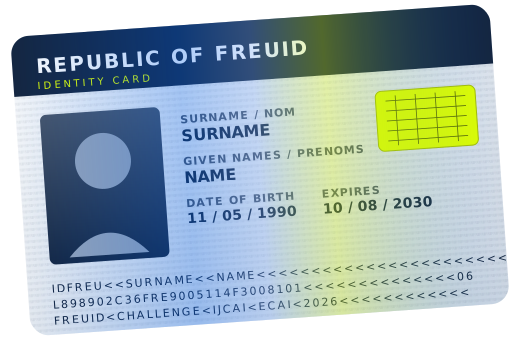
Stylized identity document with AI inspection overlay
P<UTOFREUID<<CHALLENGE<IJCAI<ECAI<2026<<<<<<<<<<<< L898902C36UTO2605118F2608216<<<<<<<<<<<<<06 BREMEN<DE<AUGUST<15<21<2026<<<<<<<<<<<<<<<<<<<<<<
About the challenge

Benchmarking ID document fraud detection in the GenAI era

$47B

Lost by American adults to identity fraud in 2024 - up $4B year-over-year.

+244%

Year-over-year surge in AI-driven digital document forgeries.

5 min

How often deepfake-based identity theft incidents now occur.

Existing benchmarks have saturated on purely digital artifacts and under-represent the global diversity of real identity documents, leaving production verification systems exposed to the next generation of attacks. The FREUID Challenge - the first competition built on the new FREUID dataset, contributed by the Microblink Fraud Lab - asks participants to detect identity document fraud across a uniquely realistic threat surface that combines:

  1. Physical manipulations on real document substrates,
  2. GenAI-driven multimodal edits accessible to common fraudsters, and
  3. Print-and-capture forgeries that close the “analog hole” most current detectors rely on.

The dataset deliberately spans under-represented document types to force cross-domain generalization. Top teams will present live at IJCAI-ECAI 2026 in Bremen.

Open problem #1

Cross-domain generalization

Build models that perform accurately across highly under-represented document types.

Open problem #2

Physical vs. digital artifacts

Move beyond fragile GenAI pixel noise toward semantic inconsistencies in physically printed and captured forgeries.

Open problem #3

Anti-fragility in vision models

Foster detectors that adapt to open-ended, continuously evolving fraud strategies rather than overfitting to known attack vectors.

Timeline

Key dates - all times 23:59 AoE (UTC-12)

    Task & Dataset

    The FREUID dataset

    FREUID is a proprietary collection of high-fidelity bona-fide and fraudulent documents provided by the Microblink Fraud Lab. It is designed to surface the failure modes hiding behind the saturated metrics of existing benchmarks.

    Differentiator #1

    Bridging the “analog hole”

    Digital forgeries are physically printed and captured to obfuscate the digital noise that SOTA detectors currently exploit. Additionally, physical forgeries are done on top of the printed documents to cover for such domain of attacks (these are again captured).

    Differentiator #2

    GenAI tampering

    Forgeries created using accessible multimodal (text + image) GenAI editing tools, reflecting the real modern threat landscape.

    Differentiator #3

    Expanded global coverage

    Document types that are under-represented in existing datasets, to test cross-document generalization.

    How FREUID compares

    Side-by-side comparison of FREUID against the closest existing identity-document fraud benchmarks.

    Feature PAD-ID Card 2025 FantasyID IDNet FREUID (Ours)
    Primary focus Presentation Attack Detection (PAD) Digital manipulation detection Large-scale synthetic dataset for ID fraud Physical & digital manipulations on under-represented document types
    Bona-fide data Printed / captured plastic cards Printed / captured “Fantasy” (mocked) plastic cards Synthetic Synthetic + printed / captured plastic cards
    Manipulations / tampering Physical & digital manipulations Digital manipulations Digital manipulations Physical & digital manipulations + print / capture
    Diversity 24 countries, 155 unique doc types (train); 4 LATAM countries, 20 doc types (test) 13 unique doc types / 10 languages 10 US and 10 EU document types 7 document types (Asian and African) with diverse scripts (Latin, Arabic)
    Evaluation

    How submissions are scored

    We adopt standard metrics from the presentation attack detection literature.

    Primary metric

    AuDET

    Area under the Detection Error Trade-off (DET) curve. A single scalar capturing the trade-off between false-accept and false-reject errors across operating points.

    Operating point

    APCER @ 1% BPCER

    Attack Presentation Classification Error Rate measured at a fixed 1% Bona-Fide Presentation Classification Error Rate - the production-relevant slice of the DET curve.

    Public leaderboard

    Powered by a validation subset; updates with every submission so teams can iterate quickly.

    Private final ranking

    Computed on a held-out test set that is never released, ensuring the leaderboard reflects true generalization.

    Rules & Awards

    Participation, prizes and reproducibility

    Eligibility & participation

    • > Open to academia and industry. Up to ~20 teams are expected.
    • > Teams may use any model architecture and any external public data.
    • > All submissions are made on the participant's own infrastructure - no GPU quota imposed by us.
    • > For final, private leaderboard evaluation, teams must provide runnable container that will be executed on our infrastructure within no-network, sandboxed environment. More information on exact requirements will be provided soon.
    • > Teams must open-source their code under an OSI-approved license to be eligible for competition.
    • > Data usage is restricted to non-commercial research.
    Prize pool

    $6,000USD

    Sponsored by Microblink. Conference entries provided to top performers (workshops/competitions part).

    1st
    $3,000
    2nd
    $2,000
    3rd
    $1,000
    Organizers

    The team behind FREUID

    Microblink
    Industrial organizer

    Microblink

    Dataset, prize pool & lead organization. The FREUID dataset is contributed by the Microblink Fraud Lab.

    Ivan Relic
    Ivan Relić
    Vincenzo D'Elia
    Vincenzo D'Elia
    Stefano Bortoli
    Stefano Bortoli
    Radu Tudoran
    Radu Tudoran
    Hristina Nedyalkova
    Hristina Nedyalkova
    Mihaela Bosnjak
    Mihaela Bošnjak
    Stanislav Pavlic
    Stanislav Pavlić
    Tin Mavracic
    Tin Mavračić
    Darin Dasic
    Darin Dašić
    Marin Kacan
    Marin Kačan
    Jerko Segvic
    Jerko Šegvić
    Paolo Ceric
    Paolo Čerić
    Filip Soprun
    Filip Šoprun
    UniZG FER
    Academic partner

    UniZG FER

    University of Zagreb, Faculty of Electrical Engineering and Computing.

    Marin Orsic
    Marin Oršić
    Politecnico di Torino
    Academic partner

    Politecnico di Torino

    DataBase and Data Mining Group.

    Lorenzo Vaiani
    Lorenzo Vaiani
    Paolo Garza
    Paolo Garza
    Contact

    Get in touch with the organizers

    Have a question about eligibility, the dataset, or the evaluation protocol? Reach out and we'll respond as quickly as we can.

    FAQ

    Frequently asked questions

    Who can participate?

    The challenge is open to academic and industry teams worldwide. We anticipate around 20 teams. Microblink employees, organizers and members of their immediate research groups are not eligible for prizes but may participate informally.

    How do I get access to the FREUID dataset?

    More information available soon.

    Are there team size limits?

    Up to five members per team. A person may only be a member of a single team. Cross-affiliation teams are encouraged.

    Are pre-trained models or external data allowed?

    Yes - any publicly available pre-trained model or dataset may be used, provided the license is compatible and the artifact is fully cited in the team's report. Use of proprietary data that is not freely accessible is not permitted.

    Do I have to release my code?

    Yes. To be eligible for competition, teams must release their training and inference code under an OSI-approved open-source license, together with a short technical report.

    Can I use the dataset commercially?

    No. The FREUID dataset is licensed for non-commercial research use only. Reach out to freuid-challenge-2026@microblink.com to discuss commercial licensing.

    Do I need to attend IJCAI-ECAI 2026 in Bremen?

    Top-three teams are strongly encouraged to attend the live award showdown on August 18-21, 2026. Conference entries are provided by the organizers to facilitate this (workshops/competitions part).

    How is the leaderboard scored?

    More information available soon.

    References

    Related work & sources

    1. Christina Ianzito (AARP). Identity Fraud and Scams Cost Americans $47 Billion in 2024. aarp.org, 2024.
    2. DeepID. DeepID Competition. deepid-iccv.github.io, 2025.
    3. Entrust. 2025 Identity Fraud Report. entrust.com, 2025.
    4. Hong Guan et al. IDNet: A Novel Dataset for Identity Document Analysis and Fraud Detection. arXiv:2408.01690, 2024.
    5. Pavel Korshunov et al. FantasyID: A Dataset for Detecting Digital Manipulations of ID Documents. arXiv:2507.20808, 2025.
    6. PAD-ID. PAD-ID Competition. sites.google.com/view/ijcb-pad-id-card-2025, 2025.
    7. Juan E. Tapia et al. Second Competition on Presentation Attack Detection on ID Card. arXiv:2507.20404, 2025.